
By: Sage Rose Brickman
For over 60 years it has been common knowledge that our solar system sported 9 planets, all rotating around a star known as the Sun. From Mercury to Earth, all the way out to Pluto, our 9 planets have unique features and characteristics that differentiate them all, but are similar enough to simplify their existence to one category. This was until 2006, when the International Astronomical Union (IAU) declared that the astronomical body Pluto was not exactly what it seemed (Tyson, 2007). Through fits of outrage from the public, the IAU successfully used evidence and research to not only prove their claims true, but officially define one of the most major components of our solar system. Today, Pluto is no longer a planet, and this change is still deemed as one of the huge stepping stones in astronomical research (Kim, 2024).
After the discovery of the solar system’s eighth planet, Neptune, in 1846, astronomers began to heavily suggest the existence of a ninth planet. Based on irregularities visible in Uranus’ orbit, scientist Percival Lowell began expressing ideas on this theoretical planet circa 1903 (Schindler and Grundy, 2018). In Lowell’s passages regarding what he referred to as “Planet X”, he called to a theory stating that wobbles found in Uranus’ orbit were due to the gravitational pull of this mysterious planet. After searching for over a decade for this unknown planet with no success, Lowell finally passed on the torch to astronomer Clyde W. Tombaugh nearly twenty years later. Using Lowell’s work as a vantage point, Tombaugh was able to discover a distant planet using microscopic and photographic technology that was unavailable to Lowell. After confirmation from several other astronomers, the discovery of Pluto was announced on the anniversary of Lowell’s birthday, March 13, 1930, from his very own observatory (Onion, et al. 2010).
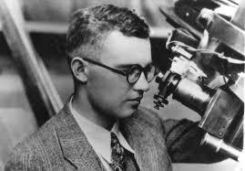
Clyde Tombaugh looking through a telescope at the Lowell Observatory (Mooney, 2021)
For approximately 75 years after this initial discovery, Pluto was treated as our solar systems' ninth planet. With a distance from the Sun of over 30 astronomical units (AUs) (Kim, 2024) and an incredibly elliptical orbit (Howett, 2019) it seemed that Pluto could fit in perfectly with its eight neighboring planets. This attempt at classification, however, shed light on some serious issues stemming from the fact that no one had truly tried defining the word “planet” since the times of ancient Greece (Tyson, 2007). As our world view shifted from geocentric to heliocentric over the course of centuries, with the realization that our solar system orbited not the Earth but the Sun, the term “planet” fell into a disorganized array of space bodies that are now considered incomparable. Asteroids, comets, and smaller celestial bodies were all vaguely categorized as one, and the growth and decline of our solar system not only frustrated amateur astronomers, but professionals who had no way to separate the larger celestial bodies from the smaller ones. Finally, after a brief stint where our solar system had a grand total of twelve planets, the IAU made the decision to establish a Planet Definition Committee, which released its first draft of the Planet Definition Resolution on August 16 of 2006 (Tyson, 2007).
In this unofficial definition that stated that round objects in orbit around the Sun are planets, Pluto and all eight other planets were able to maintain their status and worth. Unfortunately, however, this definition failed to solve the problem scientists had been dealing with regarding the classification of smaller bodies. By this definition’s standards Pluto and Jupiter were perfectly alike, regardless of their quarter-million times size difference (Tyson, 2007). Finally, on August 24, 2006, the IAU voted on an official definition to replace their first draft. According to this final vote, a planet relied on three things. First, a planet is required to orbit around the Sun. The space body must also have enough mass to be nearly spherical, or round in shape. Finally, to officially be considered a planet, the object must clear the neighborhood around its orbit (Abel, 2024). While Pluto does orbit the Sun and observe a spherical shape, it just does not have enough mass to gravitationally dominate the space surrounding its orbit (Hogeback, 2016). This was made clear to scientists upon studying Pluto’s uniquely long elliptical orbit, when it began encroaching on territory known as the “Kuiper belt”. This belt of ice-rock bodies beyond Neptune finally began to provide clarity on what Pluto may actually be, and convinced scientists that while Pluto was very interesting, it certainly was not a planet (Planetary Society).
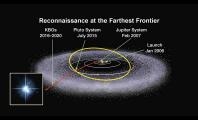
A projected doahram of Pluto and the Kuiper Belt in relation to Jupiter (NASA, 2017).
Thankfully for the masses outraged at Pluto’s demotion, scientists had no intent on scrapping the space-body entirely. In fact, this title-change only made them more interested in everything the space-body had to offer. First of all, the IAU was now able to provide a succinct definition of other kinds of objects in space known as “dwarf planets”. Clarifying that they were smaller planets who had yet to clear their orbits and were not satellites, the IAU was able to classify Pluto and several other unidentified objects that astronomers had been pondering for some time (Yeomans and Chodas, 2006). This also opened up an amazing opportunity for observations of Kuiper Belt objects that scientists could not previously recognize. The first close up observation of any of these objects took place in 2015, with NASA’s New Horizons spacecraft. The ship visited Pluto and its moons, going farther into the Kuiper Belt than anything before. While it continued on its journey to discover the edge of the Kuiper Belt, it flew past the ancient object Arrokoth in 2019, and provided humankind’s first close-up view of any icy remnants located beyond our solar system (Space Center Houston, 2020).
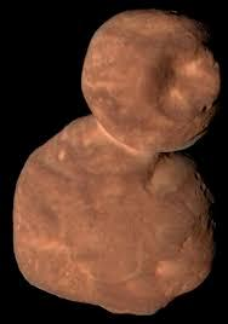
A scanned and colorized image of Arrokoth (NASA, et al., 2020)
Roughly 35 km from end to end, Arrokoth is an essential part of understanding our solar system and how it was created. As seen in Figure 3, Arrokoth appears to be two larger connecting lobes made of small bits of rock and ice. Its interesting structure begs the question: how do gas and dust clump together to make larger bodies in space? Some scientists credit planetesimal accretion, the merging of small, low-velocity objects into larger ones. Due to the general shape and orientation of both lobes to each other, accretion in this case could look more like co-orbiting bodies experiencing loss of angular momentum due to friction forces found within a condensing particle cloud. As both objects began to lose speed their gravity forces would start to pull them towards each other and the collision would have left them merged (McKinnon, et al., 2020). Other astronomers, such as JJ Kavelaars from the University of Victoria and the National Research Council of Canada, believe that this collision would be nearly impossible due to the size of each lobe. “They hit each other too fast, and they don’t stick together,” Kavelaars says. He instead believes that Arrokoth was born from the process known as gravitational instability. This occurs when a clump of materials, one of Arrokoth’s lobes, is surrounded by less dense material that is easily pulled in and attached to the mass over time. This process can form large-scale objects in thousands of years, as opposed to millions, and its consideration has entirely shifted the potential planet formation timescale (Kornei, 2022). As of now, the New Horizons is buried deep in the Kuiper Belt. 10 years since its launch have gone by, and the spacecraft's mission has switched from orbiting Kuiper Belt activity, and gathering unique heliophysics data that can be readily obtained. This will keep the ship on alert to be able to recognize any traveling Kuiper Belt objects it may encounter, and will help it manage power until its projected exit from the Kuiper Belt in 2028 (Talbert, 2023).
Launched in 2006, the New Horizons spacecraft has shown scientists celestial bodies that have never been seen before, and is helping to broaden their understanding of our very own solar system. As the craft continues on through the belt scientists hope to encounter many more Kuiper Belt objects that can help demonstrate how our planets were made (Talbert, 2023). These discoveries would not have been made without our shocking realizations about Pluto, and it is important to recognize its role in these scientific advancements. Thanks to the dwarf planet, humanity has gone farther than ever before, and will continue to explore both its surface and the rest of the Kuiper Belt until there is no stone, or rocky body, left unturned.
Works Cited
Abel, Paul. “Why Pluto Is Not a Planet.” Www.skyatnightmagazine.com, 8 Feb. 2024,
www.skyatnightmagazine.com/space-science/why-pluto-is-no-longer-planet-history-kuiper-belt-object. Academy of Achievement. “Clyde Tombaugh.” Academy of Achievement, 4 Feb. 2022, achievement.org/achiever/clyde-tombaugh/. Brown, Michael E, et al. “Discovery of a Candidate Inner Oort Cloud Planetoid.” The Astrophysical Journal, vol. 617, no. 1, 10 Dec. 2004, pp. 645–649, https://doi.org/10.1086/422095. Accessed 29 Jan. 2025.
Buie, Marc W., et al. “Orbits and Photometry of Pluto’s Satellites: Charon, S/2005 P1, and S/2005 P2.” The Astronomical Journal, vol. 132, no. 1, 5 June 2006, pp. 290–298, https://doi.org/10.1086/504422. Accessed 7 Jan. 2021.
Harvard. “SWAS Press Release - July 11, 2001.” Lweb.cfa.harvard.edu, lweb.cfa.harvard.edu/swas/pr010711/kuiperfig2thumb.html. History.com Editors. “Pluto Discovered | February 18, 1930 | HISTORY.” HISTORY, 3 Mar. 2010,
www.history.com/this-day-in-history/February-18/pluto-discovered.
Hogeback, Jonathan. “Why Is Pluto No Longer a Planet?” Encyclopædia Britannica, 2019,
www.britannica.com/story/why-is-pluto-no-longer-a-planet.
Howett, Carly. 3 0 % 8 % 9 % 1 4 % 4 % TOP 5 ELEMENTS on Mg. 2019.
Kornei, Katherine. “The Discovery of the Kuiper Belt Revamped Our View of the Solar System.” Science News, 23 Aug. 2022, www.sciencenews.org/article/kuiper-belt-discovery-solar-system-planets-space.
Lowell Observatory. “History of Pluto» Lowell Observatory.” Lowell Observatory, lowell.edu/discover/history-of-pluto/. Margot, Jean-luc. “Jean-Luc Margot | UCLA.” Ucla.edu, 2015, mel.ess.ucla.edu/jlm/epo/planet/planet.html. McKinnon, W. B., et al. “The Solar Nebula Origin of (486958) Arrokoth, a Primordial Contact Binary in the Kuiper Belt.” Science, vol. 367, no. 6481, 13 Feb. 2020, p. eaay6620, https://doi.org/10.1126/science.aay6620.
Mooney, Madison. “Who Was Clyde Tombaugh?” Lowell Observatory, 17 Feb. 2021, lowell.edu/who-was-clyde-tombaugh/. NASA. “Kuiper Belt: In Depth - NASA Science.” Science.nasa.gov, 30 Nov. 2017, science.nasa.gov/resource/kuiper-belt-in-depth/. ---. “Pluto: Facts.” NASA Science, 10 Nov. 2017, science.nasa.gov/dwarf-planets/pluto/facts/#h-structure. NASA Stem Team. “What Is Pluto? (Grades 5-8) - NASA.” NASA.gov, 4 Aug. 2015,
www.nasa.gov/learning-resources/for-kids-and-students/what-is-pluto-grades-5-8/.
New Mexico State University. “Clyde W. Tombaugh, 1906-1997 | New Mexico State University - BE BOLD. Shape the Future.” Nmsu.edu, 2024, libexhibits.nmsu.edu/onlinexhibits/tombaugh/index.html.
Owen, Tobias Chant. “Solar System | Definition, Planets, & Facts.” Encyclopædia Britannica, 26 Mar. 2019, www.britannica.com/science/solar-system.
Rayne, Elizabeth. “New Kuiper Belt Objects Lurk Farther Away than We Ever Thought.” Ars Technica, 4 Oct. 2024,
arstechnica.com/science/2024/10/new-kuiper-belt-objects-lurk-farther-away-than-we-ever-thought/.
Space Center Houston. “What Is the Kuiper Belt?” Space Center Houston, 27 May 2020, spacecenter.org/what-is-the-kuiper-belt/. Talbert, Tricia. “NASA New Horizons to Continue Exploring Outer Solar System.” NASA.gov, 29 Sept. 2023, www.nasa.gov/missions/new-horizons/nasas-new-horizons-to-continue-exploring-outer-solar-system/. Tavares, Frank. “Arrokoth Revealed: A First In-Depth Look at a Pristine World - NASA.” NASA, NASA, 14 Feb. 2020, www.nasa.gov/missions/new-horizons/arrokoth-revealed-a-first-in-depth-look-at-a-pristine-world/.
The Editors of Encyclopaedia Britannica. “Geocentric Model.” Encyclopædia Britannica, 2019,
www.britannica.com/science/geocentric-model.
The Editors of Encyclopedia Britannica. “Percival Lowell | American Astronomer.” Encyclopædia Britannica, 9 Mar. 2019, www.britannica.com/biography/Percival-Lowell.
The Planetary Society. “Pluto, the Kuiper Belt’s Most Famous Dwarf Planet.” The Planetary Society, www.planetary.org/worlds/pluto. Tyson, Neil deGrasse. “Pluto’s Requiem : Neil DeGrasse Tyson.” Neildegrassetyson.com, June 2007, neildegrassetyson.com/essays/2007-06-plutos-requiem/.
Ventrudo , Brian. “The Man of Mars – Percival Lowell and the Invention of the Red Planet - Cosmic Pursuits.” Cosmic Pursuits, 27 Mar. 2018, cosmicpursuits.com/2043/the-man-of-mars-percival-lowell-and-the-invention-of-the-red-planet/. Yeomans, Donald, and Paul Chodas. “What Is a Planet?” Ssd.jpl.nasa.gov, Oct. 2006, ssd.jpl.nasa.gov/planets/def.html.
