
By: Sebastian Borgman
Athletes worldwide are relentlessly pursuing ways to gain an edge over their opponents. They spend enormous amounts of effort and time to ensure adequate recovery. However, an effective and overlooked tool has been forgotten: sunlight. Recent studies suggest that sunlight’s vital role in repair is imperative due to its positive effects on injury prevention, muscle restoration, boosted immunity, and enhanced athletic performance (Garcia et al., 2021). This natural tool is becoming increasingly neglected as modern athletic training sequesters athletes indoors. Despite years of booming investments and analytical research into sports recovery, elite performers often remain deprived of vitamin D, a tool truly critical to optimizing athletic performance (Shuler et al., 2012).
Despite athletes completing rigorous training for high-stakes games week after week, a critical factor to understand is what holds them back: specifically, just how much vitamin D they have (or haven’t) been receiving through their hard work. A 2008 study surveyed high-level gymnasts at the Australian Institute of Sports and collected information on 25-hydroxyvitamin D
[25(OH)D] levels, a blood marker that indicates vitamin D levels. In the study, it was found that approximately 83% of the gymnasts had 25(OH)D levels below the recommended threshold of 75 nmol/L (Lovell, 2008). Given that gymnasts traditionally train indoors, the study may not come as a surprise, with a distinct lack of sun exposure explaining the deficiency. However, this issue isn’t limited to athletes competing and training indoors: a study on a professional football team, the New York Giants, was conducted in the spring of the 2011 offseason to explore vitamin
D sufficiency/insufficiency and its correlation with race, injury history, and athletic performance. Results found that the average levels of the vitamin among the 80 athletes were 27.4 ng/mL (Maroon et al. 2015), where levels under 30 ng/mL are considered inadequate, and levels under 20 ng/mL are considered deficient (Figure 1). Figure 1 displays the potential effects of each level of intake, with every case of clinical deficiency occurring among players of African American descent. In addition, players with lower vitamin D levels exhibited a greater risk of bone fracture history (Maroon et al., 2015). Looking back clearly, this study challenged notions that outdoor training alone can prevent deficiency, as the findings not only show the apparent insufficiency among outdoor athletes but also elucidate the potential injury ramifications that follow.
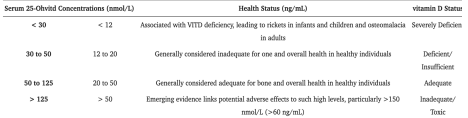
Fig. 1. Table showing each 25(OH)D intake level’s musculoskeletal impact on the body (NIH.GOV 2020).
Another important positive of Vitamin D is its role in injury prevention, often hindering an athlete's performance and timing. A common athletic impairment is stress fractures, or an injury in which repetitive stress on a bone causes small but strenuous damage. Evidence suggests
that a lack of the nutrient may increase an athlete’s individual risk of these fractures. A study was conducted on 800 Finnish male military recruits who were gathered and tested under multiple conditions, including vitamin D levels. After 90 days of rigorous training, observations were taken to determine if stress fractures during the training were significantly correlated with vitamin D deficiency. Out of the 756 who finished the study, 22 had bone fractures. Moreover, the research concluded that participants who had vitamin D levels below the median were 360% more likely to suffer a fracture (Ruohola et al., 2006). The training of soldiers' regiments involved repeated stress, particularly on the lower limbs, which is applicable to a majority of sports such as football, soccer, basketball, etc. These findings suggest that if an athlete's vitamin D medians are met or exceeded, their risk of bone fractures can be significantly decreased; clearly reflecting vitamin D’s impact on bone strength and repair (Figure 2).
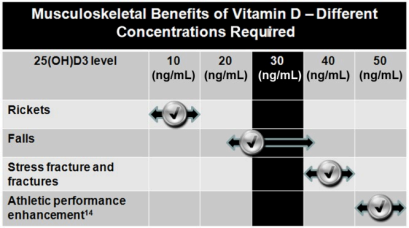
Fig. 2. Table illustrating the relationship between 25(OH)D levels and musculoskeletal health (NIH.GOV 2025).
On top of anti-bone fragment injuries, vitamin D has been shown to mitigate immune diseases. Deficiency in vitamin D is correlated with a higher prevalence of diseases such as influenza and the common cold (Yagüe et al., 2020). When these illnesses occur, inflammatory responses and tissue repair processes are interrupted, potentially interfering with critical aspects of healing, such as muscle and bone growth. Additionally, when athletes spend time off the field, they are thrown off from their pre-existing progress and coordination. Maintaining adequate levels of the vitamin is beneficial in various facets, including immune regulation, which is critical for staying consistent and not having progress delayed.
While it’s often described as the most accessible form of the mineral, obtaining sufficient vitamin D from sunlight isn’t a realistic option for everyone. Due to variables such as varying melanin levels and locations for different athletes, supplements offer a convenient solution. In 2013, the effects of vitamin D supplementation on athleticism were tested on UK athletes who lacked proper sunlight exposure due to location. The study was split into two groups over 8 weeks, and to test the effect of supplementation, they gave one group 5000 international units of vitamin D a day and the other a placebo. The supplemented group saw a significant increase in vitamin D levels from 29 to 103 nmol/L (Close et al., 2012). Moreover, 10-meter sprint times and vertical jump tests representing athleticism significantly increased in this group, whereas the placebo group showed no significant changes. The study suggested that vitamin D supplementation is a viable option for those looking to receive all of its necessary health benefits, an outstanding alternative for athletes restricted in where their practice occurs.
The importance of vitamin D cannot be overestimated, especially for athletes. Recent studies show common deficiencies even in outdoor athletes due to factors such as geography, genetics, and training locations. The research shows the importance of vitamin D and its full potential when enough is consumed. Nevertheless, if an athlete is deficient in the vitamin, supplementing is an exceptional method of intake as a solution; for many, acting as the necessary method to obtain sufficient amounts in their routine. With research continuing, maintaining adequate levels of vitamin D is a critical component of recovery, injury avoidance, and sport performance. Any athlete looking to gain an edge over their opponents, or their own nutritional well-being, should invest in this overlooked yet powerful tool.
Works Cited
Caballero-García, A., Córdova-Martínez, A., Vicente-Salar, N., Roche, E., & Pérez-Valdecantos, D. (2021). Vitamin D, Its Role in Recovery after Muscular Damage Following Exercise. Nutrients, 13(7), 2336. https://doi.org/10.3390/nu13072336
Close, G. L., Russell, J., Cobley, J. N., Owens, D. J., Wilson, G., Gregson, W., Fraser, W. D., & Morton, J. P. (2013). Assessment of vitamin D concentration in non-supplemented professional athletes and healthy adults during the winter months in the UK: implications for skeletal muscle function. Journal of Sports Sciences, 31(4), 344–353. https://doi.org/10.1080/02640414.2012.733822.
de la Puente Yagüe, M., Collado Yurrita, L., Ciudad Cabañas, M. J., & Cuadrado Cenzual, M. A. (2020). Role of Vitamin D in Athletes and Their Performance: Current Concepts and New Trends. Nutrients, 12(2), 579. https://doi.org/10.3390/nu12020579
Lovell, G. (2008). Vitamin D Status of Females in an Elite Gymnastics Program. Clinical Journal of Sport Medicine, 18(2), 159–161. https://doi.org/10.1097/jsm.0b013e3181650eee.
Maroon, J. C., Mathyssek, C. M., Bost, J. W., Amos, A., Winkelman, R., Yates, A. P., Duca, M. A., & Norwig, J. A. (2015). Vitamin D profile in National Football League players. The American Journal of Sports Medicine, 43(5), 1241–1245. https://doi.org/10.1177/0363546514567297.
Ruohola, J.-P., Laaksi, I., Ylikomi, T., Haataja, R., Mattila, V. M., Sahi, T., Tuohimaa, P., & Pihlajamäki, H. (2006). Association Between Serum 25(OH)D Concentrations and Bone Stress Fractures in Finnish Young Men. Journal of Bone and Mineral Research, 21(9), 1483–1488. https://doi.org/10.1359/jbmr.060607.
Shuler, F. D., Wingate, M. K., Moore, G. H., & Giangarra, C. (2012). Sports Health Benefits of Vitamin D. Sports Health: A Multidisciplinary Approach, 4(6), 496–501. https://doi.org/10.1177/1941738112461621
Image References
Figure - PMC. (2025). Nih.gov.
https://pmc.ncbi.nlm.nih.gov/articles/PMC3497950/figure/fig3-1941738112461621/
Table - PMC. (2020). Nih.gov.
https://pmc.ncbi.nlm.nih.gov/articles/PMC7071499/table/nutrients-12-00579-t001/
